Tuesday, 9 September 2014

Eva Peron Biography

Eva Peron Biography


Eva Peron
Eva Peron served as Argentina’s First lady from 1946 to 1952.  Eva Peron or ‘Evita’ became a powerful political figure with a large support base amongst the poor and working class trade union members. She inspired millions with her campaigns to help the poor and give women the right to vote. To her supporters she was a saint who strove to overcome poverty and injustice. To her detractors (in the nation’s military and bourgeoisie) she was a controversial figure at the heart of Argentinian politics.
“I have one thing that counts, and that is my heart; it burns in my soul, it aches in my flesh, and it ignites my nerves: that is my love for the people and Peron.”
- Eva Peron
Eva Peron was born in rural poverty in a town called Los Toldos. She was the illegitimate daughter of a failed land owner. Aged fifteen, she left her rural home to go to Buenos Aires where she hoped to pursue her theatrical career.
Aided by her natural beauty she gained work in the theatre. In Buenos Aires she also began campaigning for women to be given the vote and to deal with the widespread poverty endemic in Argentina.
She caught the eye of prominent politician, Juan Domingo Peron, and in 1945 they were married and six months later she became President Peron’s first lady.
As the president’s wife she took a high profile in campaigning for issues such as women’s rights and for the improvement of the descamisados (shirtless) i.e. the very poor.
“The nation’s government has just handed me the bill that grants us our civil rights. I am receiving it before you, certain that I am accepting this on behalf of all Argentinean women, and I can feel my hands tremble with joy as they grasp the laurel proclaiming victory.”
- Eva Peron
Her high profile, beauty and concern for the poor galvanised the nation. The dispossessed saw her as a saviour. The military and upper echelons of society saw her as a threat. They criticised her professed concern for the poor as a way to gain support for her President. Others have criticised the regime of Juan Peron for having fascist tendencies – though these remain controversial.
Her supporters dispute these assertions of her enemies, arguing the military and political opponents were merely trying to tarnish her image.
In 1952 she was given the title of ‘spiritual chief of the nation’. Six months later, in 1952, she died tragically young from cancer.
In 1955, Juan Peron was overthrown by a military coup, they took her body and had it interned in a Milanese grave under the name of a nun. They feared her legacy would provide a point of opposition to the military regime.
In 1973, Juan Peron returned to Argentina to begin a third term as president after the military regime were overthrown. Eva Peron’s body was returned in November 1974
Her life was made into a hit musical – Evita by Andrew Lloyd Weber and Tim Rice.
In 1995, Madonna starred as Evita in a high profile screen version.
Eva Peron remains an important symbol of emancipation, especially for women in Latin America. She was one of the first women to create a lasting political / humanitarian legacy. Christina Fernandez, the first female elected President of Argentina, claims that women of her generation owe a debt to Eva for “her example of passion and combativeness”.

Indira Gandhi Biography

Indira Gandhi Biography

indira-gandhiIndira Gandhi née: Nehru; (19 November 1917 – 31 October 1984) was the Prime Minister of the Republic of India for three consecutive terms from 1966 to 1977 and for a fourth term from 1980 until her assassination in 1984, a total of fifteen years. She was India’s first female Prime Minister.
In 1999, she was voted the greatest woman of the past thousand years in a poll carried by BBC news, ahead of other notable women such as Queen Elizabeth I of England, Marie Curie andMother Teresa.
Born in the politically influential Nehru dynasty, she grew up in an intensely political atmosphere. Despite the same last name, she was of no relation to the statesman Mohandas Gandhi. Her grandfather, Motilal Nehru, was a prominent Indian nationalist leader. Her father, Jawaharlal Nehru, was a pivotal figure in the Indian independence movement and the first Prime Minister of Independent India. She was brought up in an environment with great exposure to the political figures of the day, and was particularly influenced by her father. She once said: “My father was a statesman, I’m a political woman. My father was a saint. I’m not. ” In one early photograph (above), she was sitting at the bed of of Mohandas Gandhi as he recovered from one of his fasts.
In 1937, she passed the Oxford entrance exam and studied at Somerville college, Oxford. At university she was often subject to ill health, and returned to India without completing her degree – though later she was conferred an honorary degree by Oxford.
On returning to India from Oxford in 1941, Indira became involved in the Indian Independence movement. Between 1947 and 1965, she served in her father (J.Nehru’s) government. Although she was unofficially acting as a personal assistant, she wielded considerable power within the government. After her father’s death in 1964, she was appointed as Minister of Information and Broadcasting in Lal Bahadur Shastri’s cabinet. Shortly after, Shastri died unexpectedly, and with the help of Congress Party President, K. Kamaraj Indira Gandhi was chosen to be the new Prime Minister of India.
Gandhi attracted significant electoral popularity helped by her personality and populist economic measures. She introduced more left-wing economic policies and sought to promote agricultural productivity. In 1971, she led India to a decisive victory in war with Pakistan; and in 1974, India completed their own nuclear bomb. However, in the early 1970s, the Indian economy suffered from high inflation, falling living standards, and combined with protests over corruption, there was great instability that led her to impose a state of emergency in 1975. In the state of emergency, political opponents were imprisoned, constitutional rights removed, and the press placed under strict censorship. This gave her a reputation for being authoritarian, willing to ignore democratic principles.
Her son Sanjay Gandhi was also increasingly unpopular as he wielded substantial powers, such as slum clearance and enforced sterilisation to deal with India’s growing population. In 1977, against a backdrop of economic difficulties and growing disillusionment, Indira Gandhi lost the election and temporarily dropped out of politics.
However, she was returned to office in 1980. But, in this period, she became increasingly involved in an escalating conflict with Sikh separatists in Punjab. She was later assassinated by her own Sikh bodyguards in 1984 for her role in storming the sacred Golden Temple.

Short Biography of Oprah Winfrey

Short Biography of Oprah Winfrey

winfreyOprah Winfrey (1954 – ) Influential talk show host, author, philanthropist, actress and media personality. Oprah Winfrey has played a key role in modern American life, shaping cultural trends and promoting various liberal causes. Through her talk shows and books, she has focused on many issues facing American women. She has been an important role model for black American women, breaking down many invisible barriers.
“The biggest adventure you can ever take is to live the life of your dreams.”
- Oprah Winfrey
Oprah WinfreyOprah Winfrey was born in Kosciusko, Mississippi. Her parents were unmarried and broke up soon after conception. Oprah had a difficult childhood. She lived in great poverty and often had to dress in potato sacks for which she was mocked at school. She was also sexually abused at an early age.
“Turn your wounds into wisdom.”
- Oprah Winfrey
From the age of 14 she went to live with her father. Oprah says he was strict, but she was in the mood to be disobedient during her teenage years. After working her way through college she became interested in journalism and media and got her first job as a news anchor for a local TV station.
Her emotional style did not go down well for a news programme so she was transferred to an ailing daytime chat programme. After Oprah took over, the daily chat show took off and this later led to her own programme – The Oprah Winfrey Show.
The Oprah Winfrey show has proved to be one of the most successful and highly watched TV programme of all time. It has broken many social and cultural barriers such as gay and lesbian issues. Oprah has also remained a powerful role model for women, and black American women in particular. She is credited with promoting an intimate confessional form of media communication, which has been imitated across the globe.
In recent years, the Oprah Winfrey show has focused on issues of self-improvement, spirituality and self-help. Diet has also been a big issue with Oprah once successfully losing a lot of  weight. Her subsequent diet book sold millions of copies.
Oprah Winfrey has promoted many spiritual books, which have focused on the aspect of taking responsibility for your life – not changing your circumstances, but changing the way you look at your life.
What I learned at a very early age was that I was responsible for my life. And as I became more spiritually conscious, I learned that we all are responsible for ourselves, that you create your own reality by the way you think and therefore act. You cannot blame apartheid, your parents, your circumstances, because you are not your circumstances. You are your possibilities. If you know that, you can do anything.
- O Magazine (January 2007), pages 160 & 217

Oprah Wealth

Her range of media enterprises have made Oprah one of the richest self-made women. The Forbes’ international rich list has listed Winfrey as the world’s only black billionaire from 2004 to 2006 and as the first black woman billionaire in world history.In 2014 Winfrey has a net worth in excess of 2.9 billion dollars.

Book Club

The Oprah Winfrey book club has become the most influential book clubs in the world. A recommendation from Oprah Winfrey frequently sends books to the top of the best seller lists. Many commentators agree that Oprah Winfrey exerts enormous influence. Some estimated her support for Barack Obama helped him gain 1 million votes in the 2008 election.
As Vanity Fair said of Oprah Winfrey:
“Oprah Winfrey arguably has more influence on the culture than any university president, politician, or religious leader, except perhaps the Pope”

Acting career

Oprah Winfrey was also nominated for an Oscar in the film – A Color Purple. Produced by Steven Spielberg, the epic Color Purple told of segregation in America’s deep south. Oprah was widely admired for her role as Sofia.

Support for Obama

From 2006 to 2008, she lent her support to the Presidential campaign of Barack Obama. Her influence and personal following played a key role in helping Obama to become the first African American to become president.
In 2013, Oprah gained a unique interview with the professional cyclist, Lance Armstrong. It was on Oprah that Armstrong finally made a dramatic confession that he had used performance enhancing drugs during his cycling career.

Beethoven Biography

Beethoven Biography

Ludwig von Beethoven (1770 –  1827) is one of the most widely respected composers of classical music. He played a crucial role in the transition form classical to romantic music.
“Music is … A higher revelation than all Wisdom & Philosophy”
- Beethoven
Beethoven was born 16 December 1770 in Bonn (now part of Germany) From an early age, Beethoven was introduced to music. His first teacher was his father who was also very strict. Beethoven was frequently beaten for failure to practise correctly. Once his mother protested at his father’s violent beatings, but she was beaten too. It is said, Beethoven resolved to become a great pianist so his mother would never be beaten.
beethovenBeethoven’s talent as a piano virtuoso were recognised by Count Ferdinand Ernst Gabriel von Waldstein. He sponsored the young Beethoven and this enabled him to travel to Vienna, where Mozart resided. It was hoped Beethoven would be able to learn under the great Wolfgang Amadeus Mozart, but it is not clear whether the two ever met. Mozart was to die shortly, but Beethoven was able to spend time with the great composed Joseph Haydn, who taught him many things.
Rather than working for the church, Beethoven relied on private donations from various benefactors. However, whilst many loved his music, they were often not forthcoming with donations and Beethoven sometimes struggled to raise enough finance. His situation was made more difficult by his mothers early death and his fathers descent into alcoholism; this led to Beethoven being responsible for his two brothers.
Beethoven was widely regarded as a great musician, though his habits were unconventional for the social circles which he moved in. He was untidy, clumsy and (by all accounts) ugly. All attempts to make Beethoven behave ended in failure. On one occasion, Beethoven pushed his way up to the Archduke saying it was impossible for him to follow the many rules of social behaviour. The Archduke smiled and said – ‘we will have to accept Beethoven as he is.’ Beethoven himself had great faith in his own capacities, referring to the princes at court.
“There are and always will be thousands of princes, but there is only one Beethoven!”
Beethoven’s music was also unconventional, he explored new ideas and left behind the old conventions on style and form. His freer and explorative musical ideas caused estrangement with his more classical teachers like Haydn and Salieri.
As a great tragedy for any musician, from his early 20s, Beethoven experienced a slow deterioration in his hearing, which eventually left him completely deaf.
Beethoven once said:
“Music is the mediator between the spiritual and the sensual life.”
Yet, despite his deafness and the frustration this caused him, Beethoven was still able to compose music of the highest quality. He was still able to inwardly hear the most sublime music.
Beethoven was a supporter of the Romantic movement sweeping Europe. He was going to dedicate a great symphony to Napoléon, whom Beethoven believed was going to defend the ideals of the French Republic. However, when Napoléon’s imperial ambitions were made known, Beethoven scratched out his name so powerfully, he tore a hole in the paper.
Beethoven’s music
Some of Beethoven’s most memorable musical gifts include:
  • For piano: Sonata in C sharp minor, op. 27, nr. 2 “The Moonlight Sonata”
  • For piano: Sonata in C minor, op. 13, “Pathetique”
Symphonies
  • Symphony No. 3 “Eroica”; in E flat major (Op. 55)
  • Symphony No. 5 in C minor
  • Symphony No. 9 in D minor, including well known “Ode to Joy”.
Mass
  • Missa Solemnis D Major, Op. 123
Concertos
  • Piano Concerto no. 5 “Emperor” in E flat major op. 73


Beethoven’s Death
Beethoven died on March 26th, 1827. The precise cause of death is uncertain, but, the accumulation of lead poisoning is believed to have played a role. Over 10,000 people are said to have lined the streets for his funeral. Though Beethoven had a difficult temperament, and although his music was sometimes too visionary for the general public, Beethoven was appreciated for his unique contribution to music.

Lyndon Johnson Biography

Lyndon Johnson Biography

Lyndon Johnson was the 36th President of the US from 1963 to 1969. It was one of the most turbulent and influential periods in American politics. Lyndon Johnson helped to implement ‘great society’ reforms – extending welfare support and civil rights legislation. He also presided over an escalation of American involvement in Vietnam which proved increasingly controversial.
Lyndon Johnson
Johnson was born on August 27, 1908, in central Texas. Growing up in the Great Depression, he gained a first hand perspective on poverty and the great society reforms he later implemented were an attempt to make this kind of poverty a thing of the past.
He successfully won election to the House of representatives in 1937, aged only 29. During the Second World war he served in the navy, winning the silver star for service in the Pacific. In 1948, he was elected to the Senate and become the youngest minority house leader in 1953. He worked closely with Dwight D Eisenhower and helped to get some of his policies through the Senate. In 1960, he stood as vice President to the youthful John F Kennedy. The idea was that the Protestant, southern Johnson would make a dream ticket to accompany the youthful, dynamic, northern Catholic liberal, John F. Kennedy. In one of the tightest elections ever, JFK-Johnson was elected winning the 1960 election. The three years of JFK proved turbulent, with the Cuban Missile Crisis and the Cold war dominating. America also started to become involved in aiding the South Vietnamese against their northern Communist enemies.
In 1963, JFK was assassinated. Johnson was sworn in as Vice President and addressed a shocked nation.
This is a sad time for all people. We have suffered a loss that cannot be weighed. For me, it is a deep, personal tragedy. I know the world shares the sorrow that Mrs. Kennedy and her family bear. I will do my best; that is all I can do. I ask for your help and God’s. (22 November 1963)
In 1964, Lyndon Johnson was re-elected in a landslide for the Democrats. In this period, America became more involved in the Vietnam war moving from providing intelligence to bombing the north. JFK’s and Lyndon Johnson’s secretary of defence, Robin McNamara, has suggested that if JFK had lived American involvement in Vietnam would have been decreased. But, with the Gulf of Tonkin resolution of 1964, Johnson gained a free hand from Congress to take greater involvement in the Vietnam war. He said in 1965,
I do not find it easy to send the flower of our youth, our finest young men, into battle.
But, the war was increasingly escalated, and the casualties mounted. The war became increasingly unpopular and costly to the American people. By 1968, there were widespread protests and civil disobedience in protest at the war.
On a domestic front, Johnson was able to pass more legislation through Congress as part of his Great Society reforms. These extended welfare support for poorer Americans. For example, millions of elderly people benefited through the 1965 Medicare amendment to the Social Security Act. Johnson also enacted civil rights legislation protecting in law, equal rights independent of racial creed. In 1965, he introduced the Voting Rights Act
Every American citizen must have the right to vote…Yet the harsh fact is that in many places in this country men and women are kept from voting simply because they are Negroes… No law that we now have on the books…can insure the right to vote when local officials are determined to deny it… There is no Constitutional issue here. The command of the Constitution is plain. There is no moral issue. It is wrong—deadly wrong—to deny any of your fellow Americans the right to vote in this country. There is no issue of States’ rights or National rights. There is only the struggle for human rights. (15th March 1965
However, the new laws often didn’t change the situation on the ground and there were growing civil rights protests led by non violent protests by Martin Luther King and also more radical protests by Malcolm X.
Lyndon Johnson shocked American by not standing for re-election in the 1968 election. He died of a heart attack in 1973.

Rosa Parks Biography

Rosa Parks Biography

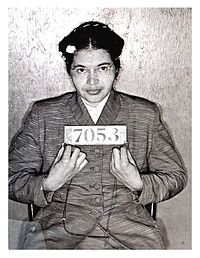
mandelaRosa Louise McCauley Parks (1913 – 2005) was an African American civil rights activist and seamstress whom the U.S. Congress dubbed the “Mother of the Modern-Day Civil Rights Movement”.
Parks is famous for her refusal on December 1, 1955 to obey bus driver James Blake’s demand that she relinquish her seat to a white man. Her subsequent arrest and trial for this act of civil disobedience triggered the Montgomery Bus Boycott, one of the largest and most successful mass movements against racial segregation in history, and launched Martin Luther King, Jr., one of the organizers of the boycott, to the forefront of the civil rights movement. Her role in American history earned her an iconic status in American culture, and her actions have left an enduring legacy for civil rights movements around the world.

Early life Rosa Parks

Rosa Louise McCauley was born in Tuskegee, Alabama, on February 4, 1913. Her ancestors included both Irish-Scottish lineage and also a great grandmother who was a slave. She attended local rural schools and after the age of 11 the Industrial School for Girls in Montgomery. However, she later had to opt out of school to look after her grandmother.
As a child, Rosa became aware of the segregation which was deeply embedded in Alabama. She experienced deep rooted racism, and became aware of the different opportunities faced by white and black children. She also recalls seeing a Klu Klux Klan march go past her house – where her father stood outside with a shotgun. Due to the Jim Crow laws, most black voters were effectively disenfranchised.
In 1932, she married Raymond Parks, a barber from Montgomery. He was active in the NAACP and Rosa Parks became a supporter helping with fund-raising and other initiatives. She attended meetings defending the rights of black people and seeking to prevent injustice.

Montgomery Bus Boycott

After a day at work at Montgomery Fair department store, Parks boarded the Cleveland Avenue bus at around 6 p.m., Thursday, December 1, 1955, in downtown Montgomery. She paid her fare and sat in an empty seat in the first row of back seats reserved for blacks in the “colored” section, which was near the middle of the bus and directly behind the ten seats reserved for white passengers. Initially, she had not noticed that the bus driver was the same man, James F. Blake, who had left her in the rain in 1943. As the bus traveled along its regular route, all of the white-only seats in the bus filled up. The bus reached the third stop in front of the Empire Theater, and several white passengers boarded.
rosaparksIn 1900, Montgomery had passed a city ordinance for the purpose of segregating passengers by race. Conductors were given the power to assign seats to accomplish that purpose; however, no passengers would be required to move or give up their seat and stand if the bus was crowded and no other seats were available. Over time and by custom, however, Montgomery bus drivers had adopted the practice of requiring black riders to move whenever there were no white only seats left.
So, following standard practice, bus driver Blake noted that the front of the bus was filled with white passengers and there were two or three men standing, and thus moved the “colored” section sign behind Parks and demanded that four black people give up their seats in the middle section so that the white passengers could sit. Years later, in recalling the events of the day, Parks said, “When that white driver stepped back toward us, when he waved his hand and ordered us up and out of our seats, I felt a determination cover my body like a quilt on a winter night.”
Rosa_Parks_BookingBy Parks’ account, Blake said, “Y’all better make it light on yourselves and let me have those seats.” Three of them complied. Parks said, “The driver wanted us to stand up, the four of us. We didn’t move at the beginning, but he says, ‘Let me have these seats.’ And the other three people moved, but I didn’t.” The black man sitting next to her gave up his seat. Parks moved, but toward the window seat; she did not get up to move to the newly repositioned colored section. Blake then said, “Why don’t you stand up?” Parks responded, “I don’t think I should have to stand up.” Blake called the police to arrest Parks. When recalling the incident for Eyes on the Prize, a 1987 public television series on the Civil Rights Movement, Parks said, “When he saw me still sitting, he asked if I was going to stand up, and I said, ‘No, I’m not.’ And he said, ‘Well, if you don’t stand up, I’m going to have to call the police and have you arrested.’ I said, ‘You may do that.’”
During a 1956 radio interview with Sydney Rogers in West Oakland several months after her arrest, when asked why she had decided not to vacate her bus seat, Parks said, “I would have to know for once and for all what rights I had as a human being and a citizen of Montgomery, Alabama.”
She also detailed her motivation in her autobiography, My Story
“People always say that I didn’t give up my seat because I was tired, but that isn’t true. I was not tired physically, or no more tired than I usually was at the end of a working day. I was not old, although some people have an image of me as being old then. I was forty-two. No, the only tired I was, was tired of giving in. ”
When Parks refused to give up her seat, a police officer arrested her. As the officer took her away, she recalled that she asked, “Why do you push us around?” The officer’s response as she remembered it was, “I don’t know, but the law’s the law, and you’re under arrest.” She later said, “I only knew that, as I was being arrested, that it was the very last time that I would ever ride in humiliation of this kind.”
Parks was charged with a violation of Chapter 6, Section 11 segregation law of the Montgomery City code, even though she technically had not taken up a white-only seat—she had been in a colored section. E.D. Nixon and Clifford Durr bailed Parks out of jail the evening of December 1.
That evening, Nixon conferred with Alabama State College professor Jo Ann Robinson about Parks’ case. Robinson, a member of the Women’s Political Council (WPC), stayed up all night mimeographing over 35,000 handbills announcing a bus boycott. The Women’s Political Council was the first group to officially endorse the boycott.
On Sunday, December 4, 1955, plans for the Montgomery Bus Boycott were announced at black churches in the area, and a front-page article in The Montgomery Advertiser helped spread the word. At a church rally that night, attendees unanimously agreed to continue the boycott until they were treated with the level of courtesy they expected, until black drivers were hired, and until seating in the middle of the bus was handled on a first-come basis.
Four days later, Parks was tried on charges of disorderly conduct and violating a local ordinance. The trial lasted 30 minutes. Parks was found guilty and fined $10, plus $4 in court costs. Parks appealed her conviction and formally challenged the legality of racial segregation. In a 1992 interview with National Public Radio’s Lynn Neary, Parks recalled:
“ I did not want to be mistreated, I did not want to be deprived of a seat that I had paid for. It was just time… there was opportunity for me to take a stand to express the way I felt about being treated in that manner. I had not planned to get arrested. I had plenty to do without having to end up in jail. But when I had to face that decision, I didn’t hesitate to do so because I felt that we had endured that too long. The more we gave in, the more we complied with that kind of treatment, the more oppressive it became. ”
On Monday, December 5, 1955, after the success of the one-day boycott, a group of 16 to 18 people gathered at the Mt. Zion AME Zion Church to discuss boycott strategies. The group agreed that a new organization was needed to lead the boycott effort if it were to continue. Rev. Ralph David Abernathy suggested the name “Montgomery Improvement Association” (MIA). The name was adopted, and the MIA was formed. Its members elected as their president a relative newcomer to Montgomery, a young and mostly unknown minister of Dexter Avenue Baptist Church, Dr. Martin Luther King, Jr.
That Monday night, 50 leaders of the African American community gathered to discuss the proper actions to be taken in response to Parks’ arrest. E.D. Nixon said, “My God, look what segregation has put in my hands!” Parks was the ideal plaintiff for a test case against city and state segregation laws. While the 15-year-old Claudette Colvin, unwed and pregnant, had been deemed unacceptable to be the center of a civil rights mobilization, King stated that, “Mrs. Parks, on the other hand, was regarded as one of the finest citizens of Montgomery—not one of the finest Negro citizens, but one of the finest citizens of Montgomery.” Parks was securely married and employed, possessed a quiet and dignified demeanour, and was politically savvy.
The day of Parks’ trial — Monday, December 5, 1955 — the WPC distributed the 35,000 leaflets. The handbill read, “We are…asking every Negro to stay off the buses Monday in protest of the arrest and trial . . . You can afford to stay out of school for one day. If you work, take a cab, or walk. But please, children and grown-ups, don’t ride the bus at all on Monday. Please stay off the buses Monday.”
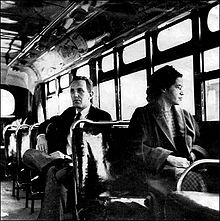
Rosa parks on a bus after the segregation law was lifted
Rosa parks on a bus (Dec 1956) after the segregation law was lifted.
It rained that day, but the black community persevered in their boycott. Some rode in carpools, while others traveled in black-operated cabs that charged the same fare as the bus, 10 cents. Most of the remainder of the 40,000 black commuters walked, some as far as 20 miles. In the end, the boycott lasted for 382 days. Dozens of public buses stood idle for months, severely damaging the bus transit company’s finances, until the law requiring segregation on public buses was lifted.
Some segregationists retaliated with terrorism. Black churches were burned or dynamited. Martin Luther King’s home was bombed in the early morning hours of January 30, 1956, and E.D. Nixon’s home was also attacked. However, the black community’s bus boycott marked one of the largest and most successful mass movements against racial segregation. It sparked many other protests, and it catapulted King to the forefront of the Civil Rights Movement.
Through her role in sparking the boycott, Rosa Parks played an important part in internationalizing the awareness of the plight of African Americans and the civil rights struggle. King wrote in his 1958 book Stride Toward Freedom that Parks’ arrest was the precipitating factor, rather than the cause, of the protest: “The cause lay deep in the record of similar injustices…. Actually, no one can understand the action of Mrs. Parks unless he realizes that eventually the cup of endurance runs over, and the human personality cries out, ‘I can take it no longer.’”
The Montgomery bus boycott was also the inspiration for the bus boycott in the township of Alexandria, Eastern Cape of South Africa which was one of the key events in the radicalization of the black majority of that country under the leadership of the African National Congress.

Rosa Parks after boycott

After the boycott, Rosa Parks became an icon and leading spokesperson of the civil rights movement in US. Immediately after the boycott, she lost her job in a department store. For many years she worked as a seamstress.
In 1965, she was hired by African-American U.S. Representative John Conyers. She worked as his secretary until her retirement in 1988. Conyers remarked of Rosa Parks.
“You treated her with deference because she was so quiet, so serene — just a very special person [CNN,2004]

Awards

Some of the awards Rosa Parks received.
  • She was selected to be one of the people to meet Nelson Mandela on his release from prison in 1994.
  • In 1996, she was awarded the Presidential Medal of Freedom from President Bill Clinton
  • In 1997, she was awarded the Congressional Gold Medal – the highest award of Congress.
rosa-parks

Death and funeral

Rosa Parks resided in Detroit until she died at the age of ninety-two on October 24, 2005.

Thomas Edison Biography

Thomas Edison Biography

Thomas Edison (1847 – 1931) was an American inventor and businessman who developed and made commercially available – many key inventions of modern life. His Edison Electric company was a pioneering company for delivering DC electricity directly into people’s homes. He filed over 1,000 patents for a variety of different inventions. Crucially, he used mass-produced techniques to make his inventions available at low cost to households across America. His most important inventions include, the electric light bulb. the phonograph, the motion picture camera, an electric car and electric power station.
“None of my inventions came by accident. I see a worthwhile need to be met and I make trial after trial until it comes. What it boils down to is one per cent inspiration and ninety-nine per cent perspiration.”
- Thomas Edison, interview 1929

Short Biography Thomas Edison

thomas-edisonThomas Edison was born in Milan, Ohio on Feb 11, 1847, the youngest of seven siblings. His parents were middle class, though they were not wealthy, especially when the railroad bypassed Milan, forcing the family to move to Port Huron, Michigan. He attended only three months of formal schooling, he irritated his teacher with his repeated questioning and inability to just follow instructions. He was largely disinterested at school, and was mainly self-educated through reading. He took upon it himself to read every book on the library shelf. By the age of 12, he was reading Sir Isaac Newton’s famous work – Principa Mathematica. However, Edison was not impressed by the complex maths of Newton, and resolved to try and make science more understandable.
As a youngster he tried various odd jobs to earn a living. This including selling candy, vegetables and newspapers. He had a talent for business, and he successfully printed the Grand Trunk Herald along with his other newspapers. This included selling photos of his hero, Abraham Lincoln. He was able to spend his extra income on a growing chemistry set.
Unfortunately, from an early age, Edison developed a severe deafness, which ultimately left him almost 90% deaf. He would later refuse any medical treatment, saying it would be too difficult to retrain his thinking process. He seemed to take his deafness in his stride, and never saw it as a disability.
edisonEdison had a big break when he saved a young boy on the railway track from being struck by a runaway train. His grateful father, J.U. Mckenzie, had Edison trained as a telegraph operator, and aged 19, Edison moved to Louisville, Kentucky to work as a telegraph operator for Western Union.
From childhood, Edison loved to experiment, especially with chemicals. however, these experiments often got Edison into difficulties. A chemistry experiment once exploded on a train, and when working on a night shift at Western Union, his lead acid battery leaked sulphuric acid through the floor onto his boss’ desk. Edison was fired the next day.
However, Edison was undimmed and despite scrapping by in impoverished conditions for the next few years, he was able to spend most of his time working on inventions. He received his first patent in June 1, 1869 for the stock ticker. This would later earn him a considerable sum.
In the 1870s, he sold the rights to the quadruplex telegraph to Western Union for $10,000. This gave him the financial backing to establish a proper research laboratory and extend his experiments and innovations. Edison once described his invention methods as involving a lot of hard work, and repeated trial and error until a method was successful.
“During all those years of experimentation and research, I never once made a discovery. All my work was deductive, and the results I achieved were those of invention, pure and simple. I would construct a theory and work on its lines until I found it was untenable. … I speak without exaggeration when I say that I have constructed 3,000 different theories in connection with the electric light, each one of them reasonable and apparently likely to be true. Yet only in two cases did my experiments prove the truth of my theory.”
- “Talks with Edison” by G.P Lathrop in Harpers magazine, Vol. 80 (Feb. 1890), p. 425
By 1877, he had developed the phonograph (an early form of the gramophone player) This received widespread interest, and people were astonished at one of the first audio recording devices. This unique invention, earned Edison the nickname ‘The Wizard of Menlo Park‘ Edison’s device would later be improved upon by others, but he made a big step in creating the first recording device.
With William Joseph Hammer, Edison started producing the electric light bulb, and it was a great commercial success. Edison’s great advance was to use a carbonised bamboo filament that could last over 1,000 hours. In 1878, he formed the Edison Electric light Company to profit from this invention. Edison successfully predicted that he could make electric light so cheap, it would soon come universal. To capitalise on the success of the electric light bulb, he also work on electricity distribution. His first power station was able to distribute DC current to 59 customers in lower Manhattan.
Edison’s studios now took up two blocks, and it was able to stock a huge range of natural resources, meaning that almost anything and everything could be used in trying to improve designs. This was a big factor in enabling Edison to be so successful in this era of innovation.
During the fledgling years of electricity generation, Edison became involved in a battle between his DC current system and the AC (alternative current) system favoured by George Westinghouse (and developed by Nikola Tesla, who worked for Edison for two years before leaving in a pay dispute.)
This became known as the ‘current war’ and both sides were desperate to show the superiority of their system. The Edison company even, on occasion, electrocuted animals to show how dangerous the rival AC current was.
During World War One, Edison was asked to serve as a naval consultant, but Edison only wanted to work on defensive weapons. He was proud that he made no invention that could be used to kill. He maintained a strong belief in non-violence.
“Nonviolence leads to the highest ethics, which is the goal of all evolution. Until we stop harming all other living beings, we are still savages.”
Edison was also a great admirer of the enlightenment thinker Thomas Paine. He wrote a book praising Paine in 1925, he also shared similar religious beliefs to Thomas Paine – no particular religion, but belief in a Supreme Being.
Edison made many important inventions and development in media. These included the Kinetoscope (or peep hole view), the first motion pictures and improved photographic paper.
After the death of his first wife, Mary Stilwell in 1884, Edison left Menlo Park and moved to West Orange, New Jersey. In 1886, he remarried Mina Miller. In West Orange, he became friends with industrial magnate, Henry Ford and was an active participant in the Civitan club – which involved doing things for the local community. His pace of invention slowed down in these final years, but he still kept busy, such as trying to find a domestic source of natural rubber. He was also involved in the first electric train to depart from Hoboken in 1930.
Throughout his life, he took an active interest in correct diet, and believed a good diet could play a large role in improving health. In 1903, he was quoted as saying:
“The doctor of the future will give no medicine, but will instruct his patient in the care of the human frame, in diet and in the cause and prevention of disease.”
He had six children, three from each marriage. Edison died of diabetes in October 18, 1931.
Citation : Pettinger, Tejvan. “Biography of Thomas Edison “, Oxford, UK –www.biographyonline.net  Last updated 17th July 2013

Quotes by Thomas Edison

“Through all the years of experimenting and research, I never once made a discovery. I start where the last man left off. … All my work was deductive, and the results I achieved were those of invention pure and simple.”
As quoted in Makers of the Modern World : The Lives of Ninety-two Writers, Artists, Scientists, Statesmen, Inventors, Philosophers, Composers, and Other Creators who Formed the Pattern of Our Century (1955) by Louis Untermeyer, p. 227
“We don’t know a millionth of one percent about anything.”
As quoted in Golden Book (April 1931), according to Stevenson’s Book of Quotations (Cassell 3rd edition 1938) by Burton Egbert Stevenson
“If we did all the things we are capable of doing, we would literally astound ourselves.”
As quoted in Motivating Humans : Goals, Emotions, and Personal Agency Beliefs (1992) by Martin E. Ford, p. 17
“To invent, you need a good imagination and a pile of junk.”
As quoted in Behavior-Based Robotics (1998) by Ronald C. Arkin. p. 8
“Just because something doesn’t do what you planned it to do doesn’t mean it’s useless.”
“Everyone steals in commerce and industry. I’ve stolen a lot, myself. But I know how to steal! They don’t know how to steal!”
As quoted in Tesla : The Modern Sorcerer (1999) by Daniel Blair Stewart, p. 411
“I consider Paine our greatest political thinker. As we have not advanced, and perhaps never shall advance, beyond the Declaration and Constitution, so Paine has had no successors who extended his principles.”
The Philosophy of Paine (1925)
“In ‘Common Sense’ Paine flared forth with a document so powerful that the Revolution became inevitable. Washington recognized the difference, and in his calm way said that matters never could be the same again..”
The Philosophy of Paine (1925)

Biography Pope John Paul II

Biography Pope John Paul II

Pope John Paul II was one of the most memorable Pope’s in the modern age. He lived through the centuries most turbulent times and offered a clear moral stance and direction to the Catholic Church. Whilst his message was not always welcomed, many felt him to be a man of profound faith and goodness.
“Strengthen the bonds that unite us and eliminate all that has divided us in the past.”
- Pope John Paul II

Early Life Karol Wojtyla

Born in Poland, 18th May, 1920, Karol Wojtyla was brought up in a turbulent period. As a young man he lived through the brutal Nazi occupation of Poland. He witnessed many atrocities and on occasions narrowly avoided with his life. It was during the war that he made the decision to train to be a priest; this had to be done clandestinely. During the war, he was also credited for trying to help Jewish friends escape persecution.
The defeat of Nazi Germany saw Poland suffer under a new occupation. Though much less brutal, the Communist state were suspicious of the Catholic church and Karol was frequently bugged by state officials. Nevertheless the young Pope developed a good reputation. He had intelligence, charisma and inspired many of his young students. His sharp intellect and practical understanding led to his rapid promotion within the Catholic clergy. At the age of 38 he was made the youngest bishop in Poland.
Starting in October 1962, Bishop Wojtyla participated in the ground breaking – Second Vatican Council which re-evaluated Catholic practises

Election to Pope

In 1978 after the death of Pope Paul VI and John Paul I (after only 33 days) Karol was elected pope making him one of the youngest pope’s and the first pope from Poland.
It was rather a surprise for John Paul. He accepted the position with humility
‘With obedience in faith to Christ, my Lord, and with trust in the Mother of Christ and the Church, in spite of great difficulties, I accept.’
Pope John Paul soon put his mark on the papacy. He travelled widely and frequently to over 120 countries. His first visit to Poland in 1978 was a sensation with huge crowds everywhere. It was credited with sparking the solidarity movement of 1980 and providing moral support for those seeking to end Soviet rule.

Pope John Paul and fall of Berlin Wall.

Spending years in Communist dominated Poland, Pope John Paul had great hopes that he could see the overthrow of Communism. President Mikhail Gorbachev paid a generous tribute to Pope John Paul’s contribution to the transition of Eastern Europe.
“Everything that happened in Eastern Europe in these last few years would have been impossible without the presence of this Pope and without the important role, including the political role, that he played on the world stage.”
Pope John Paul also made a historic visit to South Africa in 1995, he had promised he would not visit South Africa until the system of apartheid was ended. He was met at the airport by Nelson Mandela. Mandela greeted him with the words
“To say your visit is long overdue is to pay tribute to you own abhorrence of the system of apartheid. You delayed your visit to this country because you viewed with disdain a system that treated God’s children as lesser human beings.”

Pope John Paul II and Mother Teresa

Mother Teresa and John Paul were close to each other and full of admiration for their respective services. In 1994, Time magazine asked Mother Teresa for her assessment of John Paul, she replied:
Ever sustained by a profound faith,
Nourished by unceasing prayer,
Fearless in unshakeable Hope,
Deeply in Love with God.”
After Mother Teresa’s death, Pope John Paul II pushed for her canonisation. Pope John Paul made the most number of saints during his papacy. He was key in giving legitimacy to Maria Faustina (a Polish mystic) and Padre Pio (a charismatic Italian mystic)

Pope John Paul II and Other Religions

Pope John Paul II maintained good relations with other religions showing an interest in interdenominational meetings not previously seen by the Vatican. For example at Assisi in 1986, at the World day of prayer for peace, over 120 different denominations were represented as people offered prayers for peace.
In particular, his apology for anti-semitic acts in the past encouraged better relationships between Jews and Catholics.
“We are deeply saddened by the behaviour of those who in the course of history have caused these children of yours to suffer, and asking your forgiveness we wish to commit ourselves to genuine brotherhood with the people of the Covenant.”
—Pope John Paul II (12 March 2000)
The pope made over 100 apologies for various misdeeds such as women, Galileo, role in slavery, silence of Catholics during holocaust.

Devotion to Mary

Pope John Paul II had a deep devotion to the Virgin Mary. During his papacy he visited Lourdes and Fatima. In 1981, someone made an assassination attempt, although shot, the Pope survived. He credited his survival to the intervention of Our Lady of Fatima, noting it happened on the sixtieth anniversary of the Fatima apparitions. He was the first pope to have the Virgin Mary’s initials added to his banner.
The pope later met his assassin, Mehmet Ali Agca, in prison and offered him forgiveness.

Pope on Moral Issues

On moral issues, the Pope was a conservative. He opposed abortion, contraception, female priests and homosexual marriages. He was criticised for his opposition to the use of condoms to fight STD such as AIDS.
He was opposed to the Iraq war in 2003, saying the United Nations should be involved in resolving conflict not unilateral force
“Wars generally do not resolve the problems for which they are fought and therefore… prove ultimately futile.” ”
— Pope John Paul II
Pope John Paul II passed away in April 2005.

Franklin D. Roosevelt Biography

Franklin D. Roosevelt Biography

fdrFranklin Delano Roosevelt (January 30, 1882 – April 12, 1945), often referred to by his initials FDR, was the thirty-second President of the United States. He served through the Great Depression and the Second World War.
“The only thing we have to fear is fear itself.”
— Franklin D. Roosevelt, (First Inaugural Address )
FDR was elected during the height of the Great Depression in 1932 and remained President until his death in 1945. During his period of presidency he oversaw an expansion of the Federal Government and helped America lose its isolationist stance as it joined World War Two and helped formulate the United Nations. He was an influential figure in both American and world politics.
Roosevelt came from a privileged background, but was influenced by his headmaster at Groton School in Massachusetts who inculcated the importance of Christian duty in  helping less fortunate people.
Franklin married a distant cousin Eleanor in 1905. They had 6 children in quick succession, 2 of them who went on to be elected to the House of Representatives. FDR has several affairs outside of his marriage including Lucy Mercer, his social secretary.  His wife Eleanor offered a divorce at one point, but for a variety of reasons it was not taken up. She later became a dedicated wife / nurse during Franklin’s slow disability brought on by polio.

Franklin D. Roosevelt as President

When FDR was elected president in 1930, America was facing an unprecedented economic crisis; unemployment was reaching 25%  – furthermore government unemployment relief was very limited at the time. There was real economic desperation and many classical economists were at a loss as how to respond.
To some extent, FDR pursued an expansionary fiscal policy as advocated by John M Keynes. The government borrowed, levied a national income tax and spent money on public works (known as the New Deal). This period also marked a shift in power from local governments who could not cope to the national government. Roosevelt also helped introduce legislation protecting worker’s rights. The new deal in no way solved the economic crisis, but it did mitigate some of the worst effects, creating employment and eventually kick-starting the economy. By the end of the 1930s, some sectors of the economy such as construction were booming.

F.D.R and Foreign Policy

FDR was keen for America to become a good citizen of the world and fight for certain freedoms. However, in the early 1940s, America still retained a very strong isolationist approach and he campaigned for re-election promising to stay out of World War Two – despite his own dislike of Nazi Germany. The bombing of Pearl Harbour in December 1941, completely changed the outlook of America. F.D.R wasted no time in declaring war on Japan and then Germany as well.
“In these days of difficulty, we Americans everywhere must and shall choose the path of social justice…, the path of faith, the path of hope, and the path of love toward our fellow man.”
— Franklin D. Roosevelt
Once America had entered the war, they entered whole-heartedly into both arenas – the Pacific and Europe. In the D Day landings of 1941, America supplied roughly 2/3 of the troops. Roosevelt was an astute Commander In Chief. In particular, he was able to identify generals with genuine talent and promoted them to key roles. As Roosevelt said himself
“I’m not the smartest fellow in the world, but I can sure pick smart colleagues.”
In particular, FDR promoted Dwight Eisenhower and George Marshall – both to play key roles during the Second World War.

Roosevelt’s Fireside Chats

Roosevelt’s real political skill lay in his powers of communication and identification with ordinary people. His radio fireside chats, were instrumental in building confidence with the American people, both during the Great Depression and during the Second World War.
“This great Nation will endure as it has endured, will revive and will prosper. So, first of all, let me assert my firm belief that the only thing we have to fear is fear itself — nameless, unreasoning, unjustified terror which paralyzes needed efforts to convert retreat into advance.” – 1933

Roosevelt and Churchill

Roosevelt had a close relationship with Winston Churchill. There was a strong mutual admiration. At one point Roosevelt said ‘It is fun being in the same decade as you.’

Roosevelt, Churchill and Stalin.

Together with Churchill and Stalin, the Big Three helped lay the foundations for the post war period, which included the setting up of the United Nations – a successor to the League of Nations.
Roosevelt died unexpectedly from a massive brain haemorrhage in April 1945, just before the first meeting of the United Nations. His death stunned the world and he was remembered as a champion of freedom and a man of humanity and optimism.